
Guangzhou, Guangdong, China – November 03, 2026 – So, an Aluminum Decking Borad is basically a deck surface made from formed aluminum. It usually has a textured top and these channels underneath the walking surface. Some boards snap together with interlocking edges, while others attach to a separate framing system. The exact design actually matters—it affects drainage, how you fasten the boards, and the feel underfoot. Sure, on a wet morning those shallow grooves might help water run off a bit, but honestly, they’re no substitute for having the right slope and doing the installation properly.Material data actually tells you a lot about why aluminum is so appealing. The Aluminum Association puts its density at around 2.7 grams per cubic centimeter—which is roughly a third of steel’s density. So yeah, it’s lighter, and that can make handling a bit easier. But that doesn’t necessarily mean you’ll end up with a lighter finished deck than every other option out there. As for market context, Freedonia’s research on U.S. decking tracks material demand and replacement trends. It gives you useful background, but it’s not really passing judgment on any specific product. Before you commit, definitely check the technical sheet on the board—look at load ratings, finish details, slip test results, and which fasteners are approved. Honestly, the little things can trip you up. For instance, a coating might affect color retention, or if drainage isn’t planned well, water can pool right by the frame. Sure, aluminum won’t rot like wood, but it can scratch, dent, or get really hot in direct sunlight. So “maintenance-free”? Not exactly. And the sound underfoot plus the surface look? That might take some getting used to too. Honestly, comparing what’s written in the specs to what’s actually there on site gives you a way more reliable starting point than just picking something because it looks right.
 What an Aluminum Decking Board Is
An aluminum decking board is a factory-formed walking surface made from aluminum alloy, commonly extruded into long profiles. Its top face may be grooved or textured; hollow chambers and underside ribs add stiffness while limiting material use. Boards attach to joists with screws or concealed clips, depending on the system. The exact alloy, wall thickness, finish, and span rating matter more than the word “aluminum” alone. Not every profile feels solid underfoot.
Unlike wood-plastic composite, aluminum contains no wood fiber or plastic. It also conducts heat readily, so sunlit boards can feel hot. Finish, color, airflow, and shade all affect comfort. There is a materials trade-off, too. The Aluminum Association’s industry report Aluminum: The Element of Sustainability states that aluminum recycling uses about 95% less energy than producing primary aluminum, and that more than 75% of aluminum ever produced remains in use. These figures describe aluminum broadly, not any specific decking board. Ask for alloy and coating specifications, load and span data, and recycled-content documentation. Small details matter. A thin profile may save weight but require closer joist spacing; check tested specifications rather than guessing on site.
How Aluminum Decking Boards Are Made
Aluminum decking boards usually begin as alloy billets, solid cylinders of metal selected for strength, weight, and corrosion resistance. The billet is heated until it can be shaped, then pushed through a precision die. The die forms the board’s profile, including its hollow chambers, grooves, or drainage channels. Small design choices matter. A narrow groove may improve grip, but it can also collect dirt.After extrusion, the long profile cools and is straightened to reduce distortion. Workers cut it to length, inspect the edges, and prepare the surface. Depending on the specification, the board may be anodized or receive a durable coating. These finishes affect color, wear, and weather protection. Not every board is made the same way. Alloy, wall thickness, finish, and quality checks can vary, so buyers should ask how those details are controlled. An Aluminum Decking Borad Supplier should be able to explain its material records and inspection process. Still, a smooth finish alone proves little. I would want to see how the boards perform after repeated exposure to moisture, heat, and foot traffic.
What Is an Aluminum Decking Board? – How Aluminum Decking Boards Are Made
| Topic | Details | Practical Considerations |
|---|---|---|
| What it is | An aluminum decking board is a deck surface component made primarily from aluminum. Many designs use a hollow or multi-chamber profile rather than a solid slab. | Profile shape, wall thickness, and support spacing affect the board’s load capacity; follow the product’s tested specifications and installation instructions. |
| Common alloy | Extruded architectural aluminum alloys, including 6000-series alloys such as 6063, are used for many building profiles. The alloy and temper vary by product. | Do not assume every board uses the same alloy or temper. Check the manufacturer’s technical data for the specific product. |
| Typical surface features | Boards may have a textured or patterned top surface for traction, drainage channels, and interlocking or concealed-fastener edges. | Surface texture and drainage details differ. A decking profile still needs installation with the specified slope, gaps, and drainage path where required. |
| 1. Alloy preparation | Aluminum alloy is cast into billets, which are the solid feedstock used in the extrusion process. | Billet alloy composition and condition influence the properties of the finished extrusion. |
| 2. Heating and extrusion | A billet is heated and pushed through a shaped steel die. The die forms the board’s cross-section, including any hollow chambers or channels. | Extrusion creates a continuous profile; it does not by itself establish a board’s final length or surface finish. |
| 3. Cooling and straightening | After leaving the die, the profile is cooled and may be stretched or otherwise straightened to help control shape and dimensional variation. | Manufacturing tolerances are product-specific. Components should be cut and installed according to the relevant instructions. |
| 4. Heat treatment | Depending on the alloy and required temper, the profile may undergo artificial aging to develop its specified mechanical properties. | Temper designations and performance values should be verified in product documentation rather than inferred from appearance. |
| 5. Cutting and finishing | The profile is cut to length, and edges or surfaces may be prepared for finishing. Possible finishes include anodizing or an applied coating. | Finish type affects appearance and surface protection. Use compatible accessories and follow care instructions to avoid damaging the finish. |
| 6. Inspection and packing | Finished boards may be checked for dimensions, surface defects, and other specified requirements before packing and shipment. | Inspection criteria and certification vary by product and supplier; consult the relevant technical documentation. |
| Material property: density | Aluminum has a density of approximately 2.7 g/cm³. A finished board’s weight per unit length depends on its cross-section and alloy. | Use the published board weight and structural data when designing the deck; density alone does not determine a board’s load capacity. |
| Thermal movement | Aluminum expands and contracts as its temperature changes. Its linear thermal expansion coefficient is approximately 23 × 10−6 per °C near room temperature. | Allow for movement using the product’s specified end gaps, fasteners, and installation details. |
| Potential advantages | Aluminum does not rot like untreated wood and is not susceptible to termite damage. It is also noncombustible as a material. | Complete deck performance depends on the whole assembly. Coatings, substructure, connectors, and local building requirements still matter. |
| Design details to verify | Check board dimensions, span limits, support spacing, fastening method, slip-performance information, finish, and applicable load ratings. | These values vary among products. Use the current technical specifications and installation guide for the exact decking system. |
Common Types and Surface Designs
Aluminum decking boards commonly come in solid or hollow profiles. Solid boards feel substantial underfoot and may suit areas where impact resistance matters. Hollow boards are lighter, which can make handling easier, but their internal structure and support requirements vary. Check the installation guide rather than assuming every profile spans the same distance. Small details matter.Surface design affects both appearance and everyday use. Smooth finishes create a clean, contemporary look, while brushed textures soften glare and show less obvious scuffing. Woodgrain embossing can bring a warmer visual feel without using timber. Grooved or patterned surfaces add grip, though dirt may collect in deeper channels. A sample viewed indoors can look different outdoors, especially in direct sun.Color and coating choices also shape long-term maintenance. Light tones may show muddy footprints; darker finishes can reveal dust or scratches. Ask how the coating is tested and what cleaning products are suitable. An Aluminum Decking Borad Manufacturer should be able to provide profile details, finish options, and care guidance. I would not judge a board by appearance alone. Compare samples underfoot, inspect the edges, and consider how water drains across the finished deck.
Key Properties and Performance
An aluminum decking board is a formed metal plank designed to create an outdoor walking surface. It is relatively light, yet its strength allows it to support everyday foot traffic when installed over suitable framing. Aluminum does not absorb rainwater like wood, so it is less prone to swelling, splitting, or decay. Its surface may also resist corrosion, especially when protected by a durable finish. The finish matters. Scratches or poor drainage can expose areas to wear, so regular inspection is still useful.Performance depends on the board profile, support spacing, and installation details. Follow the manufacturer’s span guidance; a strong board can still feel springy if its framing is too widely spaced. Aluminum expands and contracts with temperature changes, so joints need room to move. In direct sun, the surface can become hot, particularly in darker colors. A textured finish can improve grip, though dust and algae may reduce traction when the deck is wet. Metal may also sound sharper underfoot than wood. That takes adjustment. These trade-offs are easy to overlook when choosing a deck by appearance alone.
Where Aluminum Decking Boards Are UsedWhat Is an Aluminum Decking Board?Where Aluminum Decking Boards Are Used
An aluminum decking board is an extruded metal plank designed to form an outdoor walking surface. It is often chosen where moisture, frequent use, or a long service life matters. The best location depends on the board profile, support spacing, finish, and installation details.
On residential decks, aluminum boards can suit elevated patios, balconies, and poolside areas. Their gaps or drainage channels help water move away instead of collecting on the surface. That can be useful after rain or when swimmers track water across the deck. Still, bare feet may find sunlit metal hot. Shade and surface finish matter.
They also appear on docks, rooftop terraces, and commercial walkways. Near water, corrosion-resistant aluminum can be a practical choice, but fasteners and nearby materials need compatible specifications. Rooftop projects may benefit from a lightweight deck surface, though the supporting structure and drainage still require careful review. Busy public paths need secure edges and a surface that remains dependable when wet. Details count.
Not every site is an obvious fit. Footsteps can sound sharper on metal, and poor installation may create movement or noise. These trade-offs deserve a real site check, not just a product comparison.
How Aluminum Decking Boards Are Installed
Aluminum decking boards are usually fixed to a level support frame, not laid directly on soil or concrete. Begin by checking the framing for straightness, spacing, and secure connections. Small errors become obvious once the boards are down. Follow the board maker’s installation guide, since profiles and fasteners can differ. Leave the specified gaps at board ends and between boards so water can drain and materials can move with temperature changes.Cut boards with a tool suited to the product, and wear eye and hearing protection. Remove sharp burrs before handling cut edges. Install hidden clips or approved screws at each support point, keeping fasteners aligned rather than forcing a board into place. I would not rush this part. A crooked first board can shift the whole deck. When comparing advice from an Aluminum Decking Borad Factory, ask for its support-spacing limits, expansion details, and compatible fasteners. Check those instructions against the actual site conditions. For example, a shaded, damp corner may need extra attention to drainage. Inspect the finished surface for loose fasteners, trapped debris, and uneven board ends; even careful work can miss one.
Care, Maintenance, and Service Life
An aluminum decking board uses an aluminum profile as its walking surface, often with a protective finish. Care is straightforward, but exposure matters. Rinse away salt, pollen, and dirt with clean water; use mild soap and a soft brush for stuck-on grime. Clear leaves from gaps so water can drain and debris does not stay pressed against the surface. Avoid harsh abrasives unless the finish maker approves them. I would not call any deck maintenance-free. Small task. Worth doing.Service life depends on the alloy, coating, fasteners, installation, and local conditions, so a universal lifespan would be misleading. The International Aluminium Institute reports that roughly 75% of all aluminum ever produced remains in use today. That broad material statistic is not a decking-life guarantee, but it does show aluminum’s potential for long-term use and recycling. Inspect the boards each year, especially near the coast: check for loose fasteners, damaged finish, and trapped moisture around joints. Ask Aluminum Decking Borad Factories for coating specifications, compatible cleaning methods, and clear warranty terms. A shiny surface can hide a weak fixing detail. Don’t skip the underside.
What Is an Aluminum Decking Board? Care, Maintenance, and Service Life
An aluminum decking board is a deck surface made from corrosion-resistant aluminum. It typically needs occasional cleaning, but its service life depends on the product, installation, climate, and care.
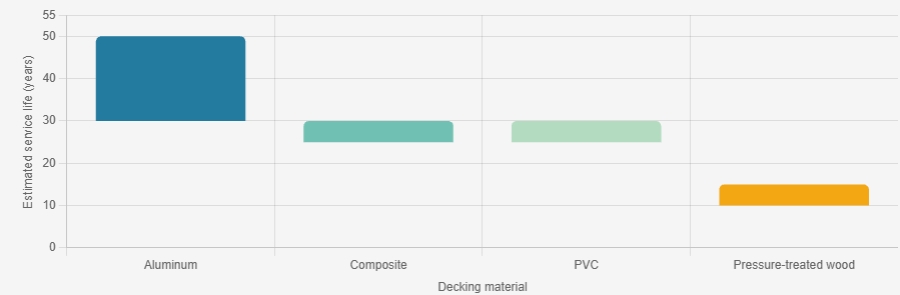
Indicative service-life estimates: Aluminum, 30–50 years; composite, 25–30 years; PVC, 25–30 years; and pressure-treated wood, 10–15 years. These are general estimates, not guarantees. Follow the decking manufacturer’s care instructions; routine cleaning helps remove dirt and debris.
Conclusion
An Aluminum Decking Borad is a deck surface made from shaped aluminum profiles, designed to provide a durable alternative to traditional wood or composite boards. It is typically manufactured by forming or extruding aluminum into hollow or solid sections, then finishing the surface with coatings, textures, or patterns that can improve grip and appearance. Common designs include smooth, grooved, and embossed surfaces, with different profiles suited to varied structural and visual needs.Lightweight yet strong, aluminum decking resists moisture, rot, insects, and many forms of weathering, while its performance depends on the profile, finish, and installation. It is used on balconies, patios, walkways, docks, and other outdoor areas. Installation generally involves fixing boards to a supporting frame with compatible fasteners, allowing for proper spacing, drainage, and movement. Routine cleaning and occasional checks of fasteners and finishes help maintain its appearance and service life.
About Us
HOYEAH is a leading manufacturer specializing in the production of eco-friendly high-end wood-plastic composite (WPC) products.
Leveraging cutting-edge material technology, the company delivers sustainable solid wood alternatives that seamlessly combine the aesthetic appeal of natural wood grain with superior weather resistance.
Media Contact
Company Name: Guangzhou Hoyeah Composite Materials Co., Ltd
Contact Person: Media Relations
Email: Send Email
Country: China
Website: https://www.hoyeahchina.com/
Press Release Distributed by ABNewswire.com
To view the original version on ABNewswire visit: Exploring What Defines a HighPerformance Aluminum Decking Board Today


