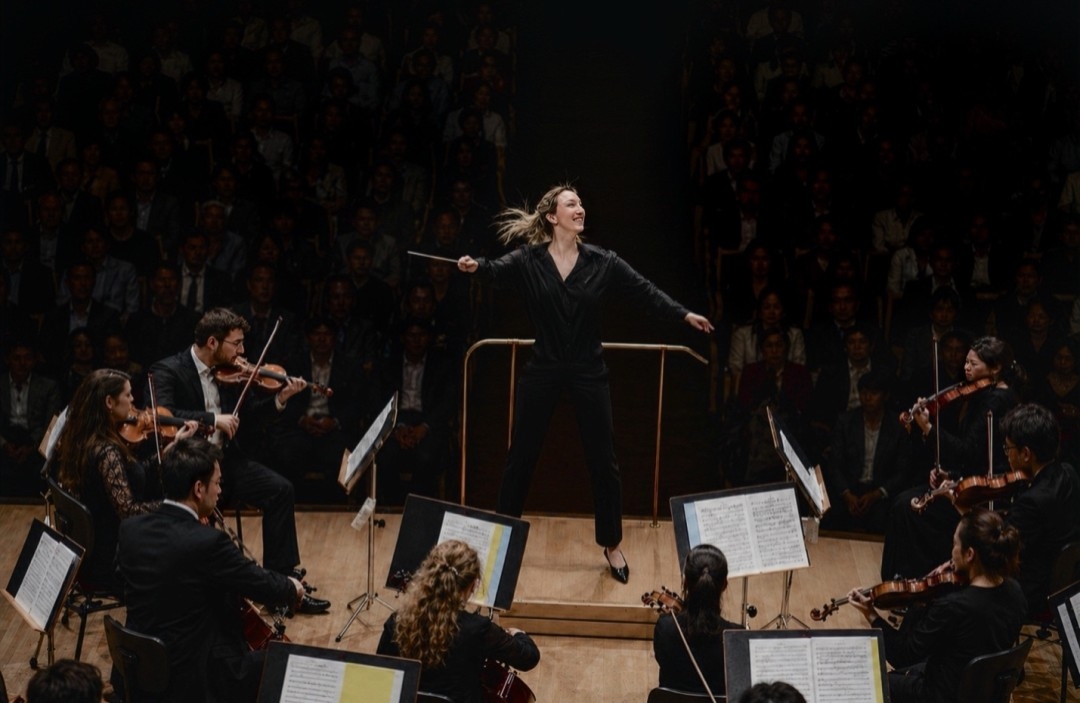
(Photo Credit: Mathieu Laurent)
CANNES, France – At a moment when classical music is once again being asked to justify its place in contemporary culture, some responses come in the form of statements. Others, more quietly, take shape in practice.
Backstage, after the audience has dispersed, the 00s-born conductor Cara Xu has just finished concerts with Orchestre National de Cannes. Her suitcase remains open — as it has for most of the past six months.
Still in her early twenties, Cara Xu has appeared with major orchestras across Europe and the United States, becoming one of the most visible examples of a new generation entering the international stage.
In February and March, she appeared on stages in Helsinki and Prague before traveling to Cannes. After a brief stay in France, she returned to Berlin for opera rehearsals and is preparing for upcoming concerts in Croatia and Greece in April.
The pace reflects a professional rhythm that has become increasingly common among younger conductors working internationally, where mobility and continuity often replace long-term institutional attachment.
Cara Xu’s background reflects an unusually wide-ranging profile for a conductor of her generation. Studying conducting and piano at the Juilliard School, she was simultaneously enrolled at Columbia University, earning a degree in economics and mathematics. She speaks four languages and, during her time at Columbia, competed in Ivy League tournaments as part of the university’s women’s golf team.
Maintaining both paths required navigating overlapping demands — practice room, rehearsals, sports and coursework — in a discipline where early specialization has historically been the norm.
Over the years, she has always balanced music education with academic study. During her student years, Xu frequently traveled between the United States and Europe for concerts and masterclass training, at times returning from transatlantic flights to sit for academic exams days after.
However, her dual track has drawn skepticism. Some within the music field, where traditional conservatory systems have long emphasized full immersion in performance, have questioned whether it is possible to sustain the level of focus required for orchestra conducting, or whether such breadth comes at the expense of specialization.
Cara Xu’s career development resolves the skepticism, showing a growing number of musicians how she tests the limits of how such paths can be sustained. Since completing her university studies, her calendar has been filled with concert engagements across multiple countries, reflecting a level of activity that has become increasingly visible among younger conductors navigating parallel paths.
“We’re seeing more musicians with hybrid backgrounds,” said a Berlin-based arts administrator familiar with cross-institutional training programs. “It changes not only how they perform, but how they think about the structure of the industry.”
Cara Xu began working within major institutions early in her career, including roles connected to the New York Philharmonic and the Metropolitan Opera, gaining experience in large-scale productions. Her work has since extended across Europe, with collaborations involving the Semperoper Dresden and the Komische Oper Berlin, among others.
In 2025, she made her debut at the Berliner Philharmonie with Berlin Symphony Orchestra Since then, she has received a growing number of engagements with orchestras and opera houses.
Her work, however, extends beyond performance alone. In addition to conducting, Xu has been involved in initiating residency-based projects that combine composition, rehearsal and recording in immersive formats. These projects often prioritize long-term artistic output and digital dissemination over traditional concert-based models. Such approaches reflect a broader shift in how classical music is produced and shared, particularly among younger artists navigating multiple roles.
In recent months, questions about the cultural relevance of classical performance have resurfaced in public discussions. Remarks by actor Timothée Chalamet, questioning the place of opera and ballet in contemporary culture, circulated widely online and prompted debate across arts communities.
While responses from institutions have varied, changes within the field itself are unfolding more gradually.
“In Europe, we’re not seeing a sudden break,” said the Berlin-based administrator. “But there is a steady expansion of what it means to build a career in classical music.”
Conducting has historically been associated with a narrow image — one shaped over decades by male figures on major stages. While the number of women on the podium has increased in recent years, they remain underrepresented in many leading orchestras.
For Xu, the question is not only about representation, but about perception.
“If one day, when people think of an orchestra conductor, the first image that comes to mind could be a young woman — that would already mean something has changed,” she said.
Xu said she hopes her work can encourage more young women to consider classical music, whether as instrumentalists or conductors.
“The music training itself goes beyond performance,” she said. “It involves self-discipline, time management, team building… and these skills extend well beyond music.”
Xu also encourages younger conductor to develop professional identities extend beyond the podium. Alongside performance, she is increasingly engaged in project development, interdisciplinary collaboration, and new forms of cultural production associated with local economics and tourism.
For some emerging musicians, such trajectories suggest a wider range of possibilities within a field long defined by specialization and institutional pathways.
Whether classical music is losing its audience remains an open question. But alongside public debate, a quieter transformation continues — shaped by new participants, new formats and evolving expectations.
Back on stage, the image remains familiar: a conductor raises her arms, and an orchestra responds.
Beyond that moment, the work continues — across cities, institutions and formats — reflecting how a new generation is navigating the future of the art form.
Media Contact
Company Name: PINYUAN INTERNATIONAL TRADING CO., LIMITED
Contact Person: Hank Hsu
Email: Send Email
Country: China
Website: www.pinyuaninfo.com