
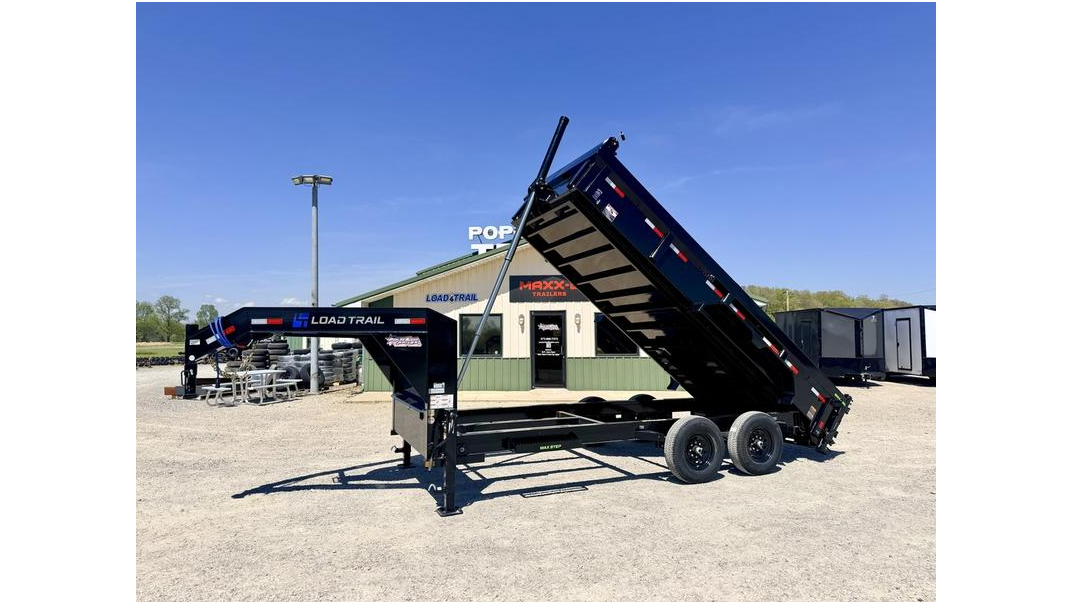
Key Takeaways
- A 14,000 lb Load Trail Tilt Trailer offers 10,634 lbs of payload, while a comparable MAXX-D tilt model offers 9,010 lbs, a gap that matters when weighing equipment against a trailer’s floor
- MAXX-D backs its tilt trailers with a 5-year structural warranty compared to Load Trail’s 3-year structural warranty, though both include a 2-year full-coverage warranty
- Axle setup, deck style, and warranty length all factor into which gooseneck brand fits a given hauling job best
- Both Load Trail and MAXX-D scale up to heavy-duty gooseneck models with GVWRs reaching 40,000 lbs for contractors moving bigger equipment
Heavy haulers rarely have the luxury of picking a trailer on looks alone. Every deck length, axle rating, and tilt mechanism has to earn its place on a job site, whether that means dragging a skid steer through mud or hauling a compact excavator down the highway.
Two names come up again and again in these conversations: Load Trail and MAXX-D. Both brands build gooseneck and tilt trailers designed for serious work, but the details separate them in ways that matter to contractors and equipment operators.
14,000 lb Tilt Trailers Go Head-to-Head
A good way to compare these brands is to look at similarly rated trailers side by side. On paper, the two look evenly matched. Once the specs are laid side by side, though, real differences start to show up in payload, axle type, and deck design.
Payload Capacity: The Real Difference
GVWR only tells part of the story. Payload capacity, the actual weight a trailer can carry once its own weight is subtracted, is what determines whether a piece of equipment will fit.
The Load Trail TH8316 Tilt Trailer carries an estimated payload of 10,634 lbs on its 14,000 lb GVWR frame. The MAXX-D T6B10224 Tilt Trailer, also rated at 14,000 lbs GVWR, carries a payload of 9,010 lbs. That difference of more than 1,600 lbs comes down to construction weight and deck length, since the MAXX-D model stretches to 24 feet compared to Load Trail’s 16-foot deck. A longer deck adds versatility for larger loads while also adding trailer weight, which eats into payload.
For a contractor hauling a mini excavator or a compact track loader, that payload gap could decide whether the load stays comfortably under GVWR or pushes right up against it.
Axles and Suspension: What Holds the Load
Both trailers in this comparison run two 7,000 lb axles, but the suspension type differs. The Load Trail Tilt Trailer uses Dexter Torsion Axles, which tend to deliver a smoother, quieter ride for moderate loads. The MAXX-D Tilt Trailer uses electric brake axles paired with torsion spring suspension.
Spring axles are often favored for heavier loads because of their strength and load distribution, while torsion axles tend to shine on lighter to moderately loaded trailers with a quieter ride. That distinction matters when matching a trailer to the kind of equipment it will haul most often, since a torsion setup that feels great empty can behave differently loaded near capacity.
Deck and Loading Features Compared
Loading and unloading heavy equipment safely depends heavily on deck design.
The Load Trail Tilt Trailer features a 16-foot gravity full tilt deck, which uses the weight of the equipment to tilt the bed down for loading, plus a spare tire mount, tool tray, LED lighting package, and a cold weather wiring harness upgrade.
The MAXX-D Tilt Trailer instead uses a full deck power tilt system, meaning the tilt is hydraulically powered rather than gravity-assisted. It also includes drive-over fenders, a spare tire and mount, flushmount LED lighting, an integrated toolbox, a tool tray behind the toolbox, and a winch plate.
Gravity tilt systems tend to cost less and have fewer moving parts, while power tilt systems offer more control when loading on uneven ground or with sensitive equipment. Neither approach wins outright; the right choice depends on the terrain and equipment being hauled most often.
Structural Warranty Coverage Compared
Warranty length is one of the clearest ways to compare long-term confidence in a trailer’s build.
- Load Trail backs its TH8316 Tilt Trailer with a 3-year structural warranty and a 2-year parts and labor warranty.
- MAXX-D backs its T6B10224 Tilt Trailer with a 5-year structural warranty and a matching 2-year full-coverage warranty.
That two-year gap in structural coverage stands out as one of the more tangible differences between the brands at this GVWR class, and it factors into any decision involving daily or heavy-duty use.
Scaling Up for Heavier Equipment
Many contractors eventually outgrow a 14,000 lb trailer, especially as fleets add larger skid steers, compact dozers, or mid-size excavators. Both brands offer heavy-duty gooseneck lines built for exactly that jump.
Load Trail’s Heavy-Duty Gooseneck Options
Load Trail’s GH Heavy-Duty Gooseneck series spans a wide range, with GVWRs from 14,000 lbs up to 24,000 lbs on some models and from 22,000 lbs up to 30,000 lbs on others, built with a 12-inch I-beam frame and two or three axles rated between 10,000 lbs and 15,000 lbs.
The GT Tandem Dual Gooseneck Tilt Trailer (GT22) carries a 22,000 lb GVWR with two 10,000 lb Dexter electric brake axles and Dexter’s Heavy Duty Suspension System, while other GT configurations reach a 24,000 lb GVWR with two 12,000 lb axles.
Load Trail’s deckover lineup breaks down by series: the Classic Deckovers top out at 16,000 lbs GVWR, the Heavy-Duty Trailers series climbs to 30,000 lbs GVWR, and the Low-Pro Deckovers series reaches as high as 40,000 lbs GVWR for the heaviest commercial loads.
MAXX-D’s Heavy-Duty Gooseneck Options
MAXX-D’s LDX Low Profile Gooseneck Trailer starts at a 22,500 lb GVWR, upgradeable to 30,000 lbs, and uses a 14-inch engineered beam frame on most models, with some configurations built on a 12-inch engineered I-beam frame; a pierced-beam design lowers deck height to around 32 inches for easier loading of low-clearance machinery.
The TDX heavy-duty tilt trailer starts with two 10,000 lb tandem dual axles at a 22,500 lb GVWR, upgradeable to 30,000 lbs, with 12,000 lb or 15,000 lb axle configurations also available.
For the heaviest jobs, MAXX-D’s LHX 40K Gooseneck Trailer carries a 40,000 lb GVWR with up to 30,000 lbs of carrying capacity, equipped with twin 16K electric-over-hydraulic brake axles or three 12K axles.
The 2026 YHX deck-over model also reaches a 40,000 lb GVWR, running on twin 16K electric-over-hydraulic brake axles or three 12K electric-over-hydraulic brake axles, with adjustable suspension standard and Ridewell airbag suspension available as an option.
The Right Trailer Depends on the Job
Neither brand wins across every category. Load Trail tends to offer a lighter build with strong payload numbers at a given GVWR, which suits haulers who want to maximize what they can legally carry. MAXX-D tends to lean into longer warranties, power tilt convenience, and engineered frame designs that lower deck height for tricky loading situations.
The best approach matches the trailer to the actual equipment being hauled, the terrain it will cross, and how much loading convenience matters day to day. Contractors moving mid-size equipment on rough sites may lean toward MAXX-D’s power tilt and lower deck height, while those prioritizing payload and simplicity may find Load Trail’s lighter build a better fit.
Poplar Bluff Trailer
135 Hwy T Suite B
Poplar Bluff
Missouri
63901
United States


